
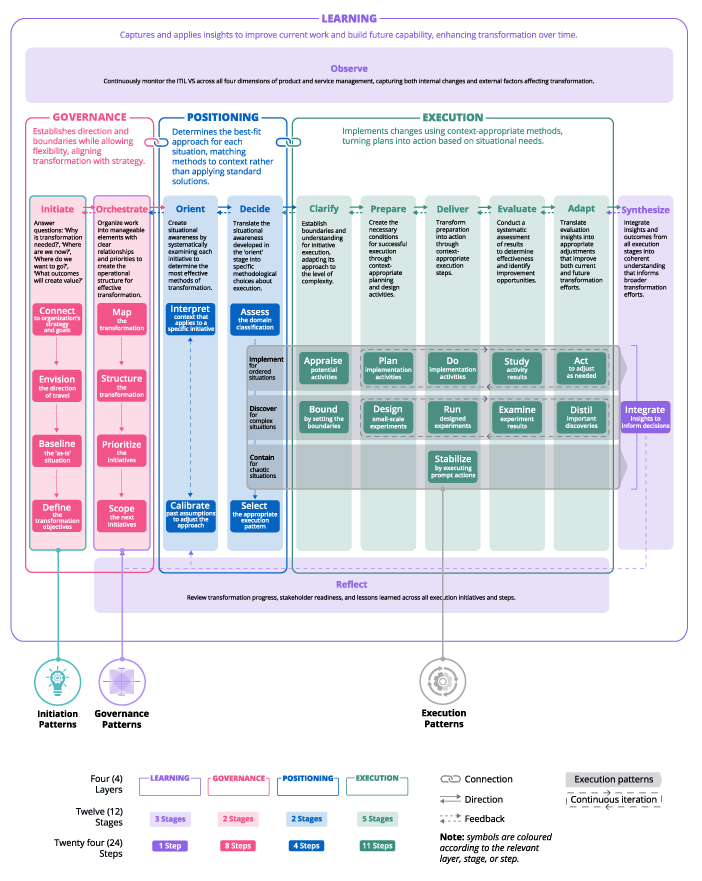
The ITIL Transformation Model is a structured way to redesign an organisation's ITIL Value System rather than just tweak parts of it. Introduced in ITIL Version 5, it organises transformation work into four layers, twelve stages, and twenty-four steps, giving teams a shared map for change that is large, uncertain, or strategically significant. If you have ever watched a "transformation programme" turn into a pile of disconnected projects, this model is the antidote. It keeps governance, context, delivery, and learning working together instead of pulling apart.
What problem does the Transformation Model actually solve?
ITIL Transformation Model: Big Picture
The four layers
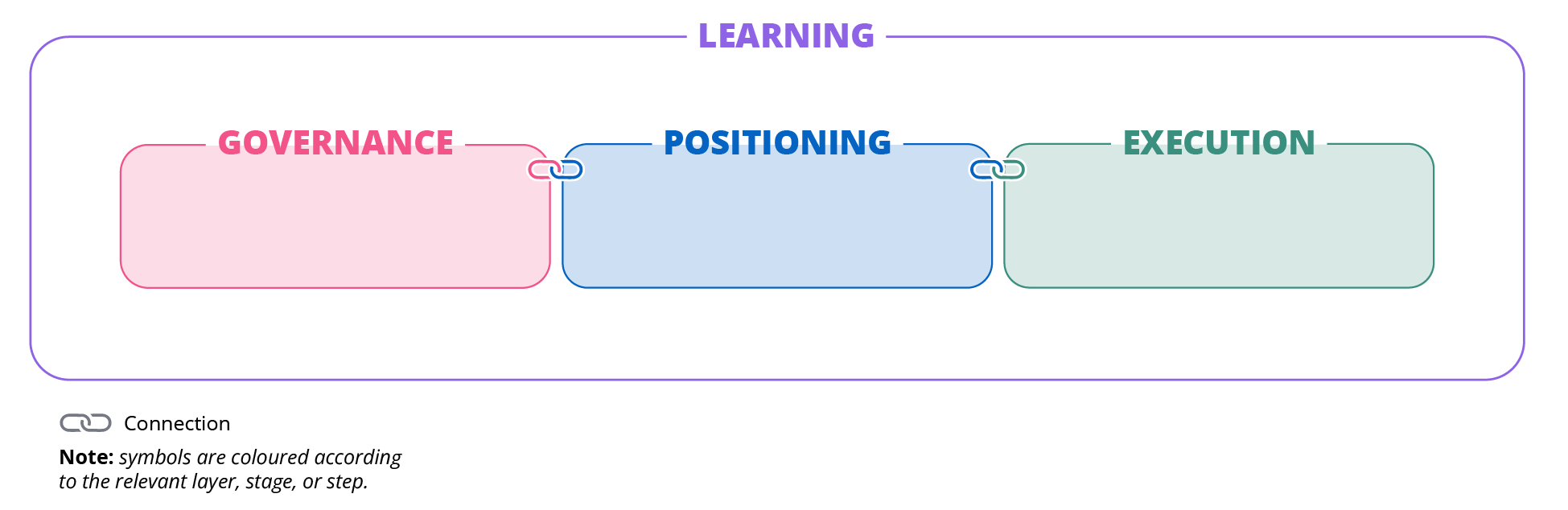
The model's backbone is four layers that run in parallel rather than in sequence. Each answers a different question.
Governance keeps transformation aligned to organisational strategy while leaving room to adapt. The point is not control for its own sake. Good governance clarifies why the transformation exists, what outcomes it should produce, and how effort should be structured, then it gets out of the way. Too much control and teams cannot respond to what they learn. Too little and the work fragments. The skill is setting clear boundaries inside which people are free to innovate.
Positioning is where you read the context before choosing a method. Some situations have clear cause and effect and reward established practice. Others need expert analysis. Others are genuinely complex, where outcomes only emerge through experimentation, and a few are chaotic and need immediate stabilising action. Positioning prevents the classic failure of applying a familiar approach to a situation that does not fit it, and it lets you re-read the context as conditions change.
Execution turns decisions into real change using whichever method the context calls for. In ordered contexts you apply structured, disciplined delivery. In complex contexts you run structured experiments and adapt to what emerges. In chaotic contexts you act fast to contain disruption and establish order. The layer's whole logic is matching the method to the situation rather than to organisational habit.
Learning captures insight at every stage and feeds it back into the other three layers. It stops transformation from becoming a one-off event by building explicit feedback loops, so lessons become organisational knowledge instead of evaporating under delivery pressure. Learning happens at three levels: fast micro-cycles inside execution, a reflection loop across workstreams, and continuous observation across the whole effort.
The twelve stages
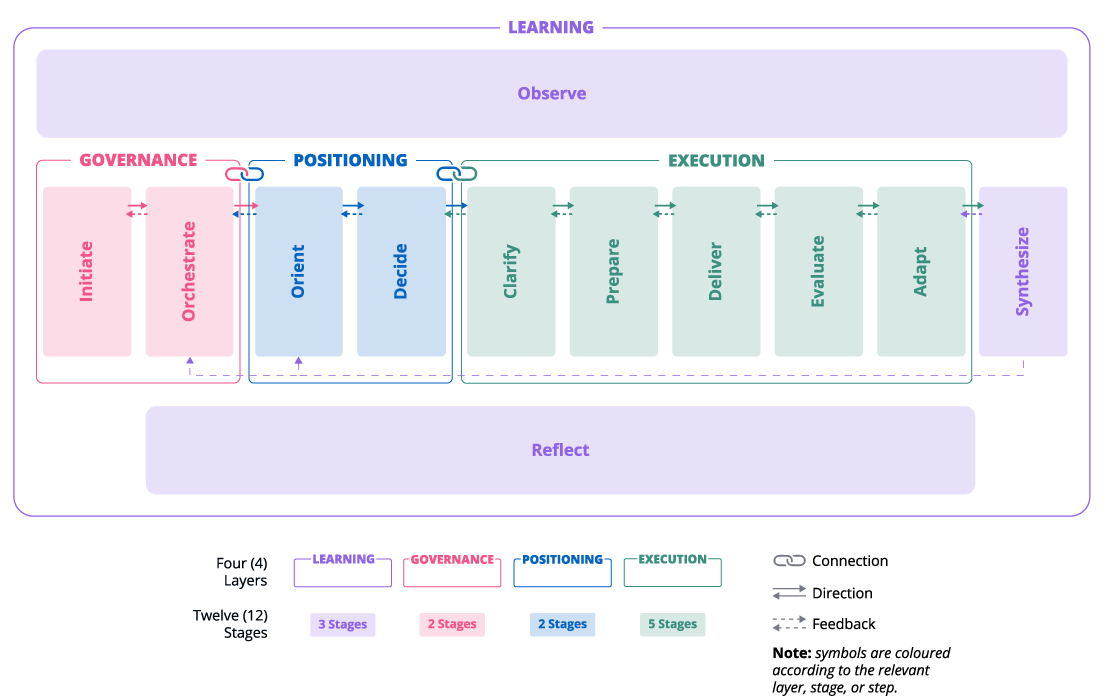
Each layer breaks down into stages, twelve in total.
The twenty-four steps
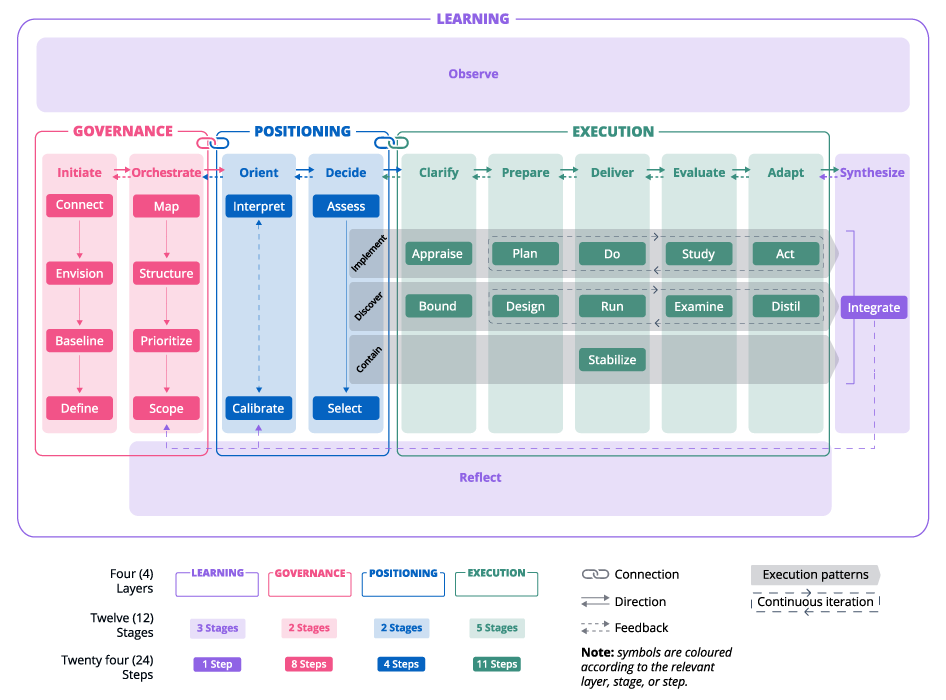
Stages then resolve into twenty-four named steps.
In the Governance layer, Initiate runs through Connect, Envision, Baseline, and Define, while Orchestrate runs through Map, Structure, Prioritize, and Scope.
In Positioning, Orient covers Interpret and Calibrate, and Decide covers Assess and Select.
Finally, the Learning layer's Synthesize stage includes the Integrate step, where insight is woven back into the system. Add these up and you reach the model's twenty-four steps.
In the Governance layer, Initiate runs through Connect, Envision, Baseline, and Define, while Orchestrate runs through Map, Structure, Prioritize, and Scope.
In Positioning, Orient covers Interpret and Calibrate, and Decide covers Assess and Select.
The Execution layer is the part people find most interesting, because its steps depend on the context you identified during Positioning. It offers three execution patterns:
- Implement (for ordered contexts): Appraise, Plan, Do, Study, Act. A disciplined cycle for known problems.
- Discover (for complex contexts): Bound, Design, Run, Examine, Distil. A structured experiment for problems whose solution must be found.
- Contain (for chaotic contexts): Stabilize. Rapid action to restore order before anything else.
Finally, the Learning layer's Synthesize stage includes the Integrate step, where insight is woven back into the system. Add these up and you reach the model's twenty-four steps.
Do the stages run in order?
Who is this model for?
Advance your career with flexible, practice-driven training in Product Management, Product Ownership, Service Management, and Project Leadership
Copyright © 2026 AGILEPM HUB
ITIL® and the Swirl logo are registered trademarks of the PeopleCert group. Used under licence from PeopleCert. All rights reserved.
PRINCE2® and PRINCE2 Agile® are registered trademarks of the PeopleCert group. Used under licence from PeopleCert. All rights reserved.
AGILEPM HUB is a PeopleCert Accredited Training Organization (ATO) for ITIL® and PRINCE2® in Hong Kong.
You can check our profile page: https://www.peoplecert.org/ways-to-get-certified/ato/agilepm-hub-2762171
Created with