
What is the PRINCE2 certification path, and which module should you take next?
If you have looked at PRINCE2 recently, you have probably noticed it is no longer one certification with two levels. PeopleCert has reorganised the whole family into six designations, each aimed at a different role, and each built from one or two modules.
That is good news if you know where you are going, and confusing if you do not. This guide lays out the entire scheme in one place: what each designation is, what it requires, what the exams look like, and how to pick the right starting point.
It is written for people choosing their next certification, not for people who already know the answer.
The big picture
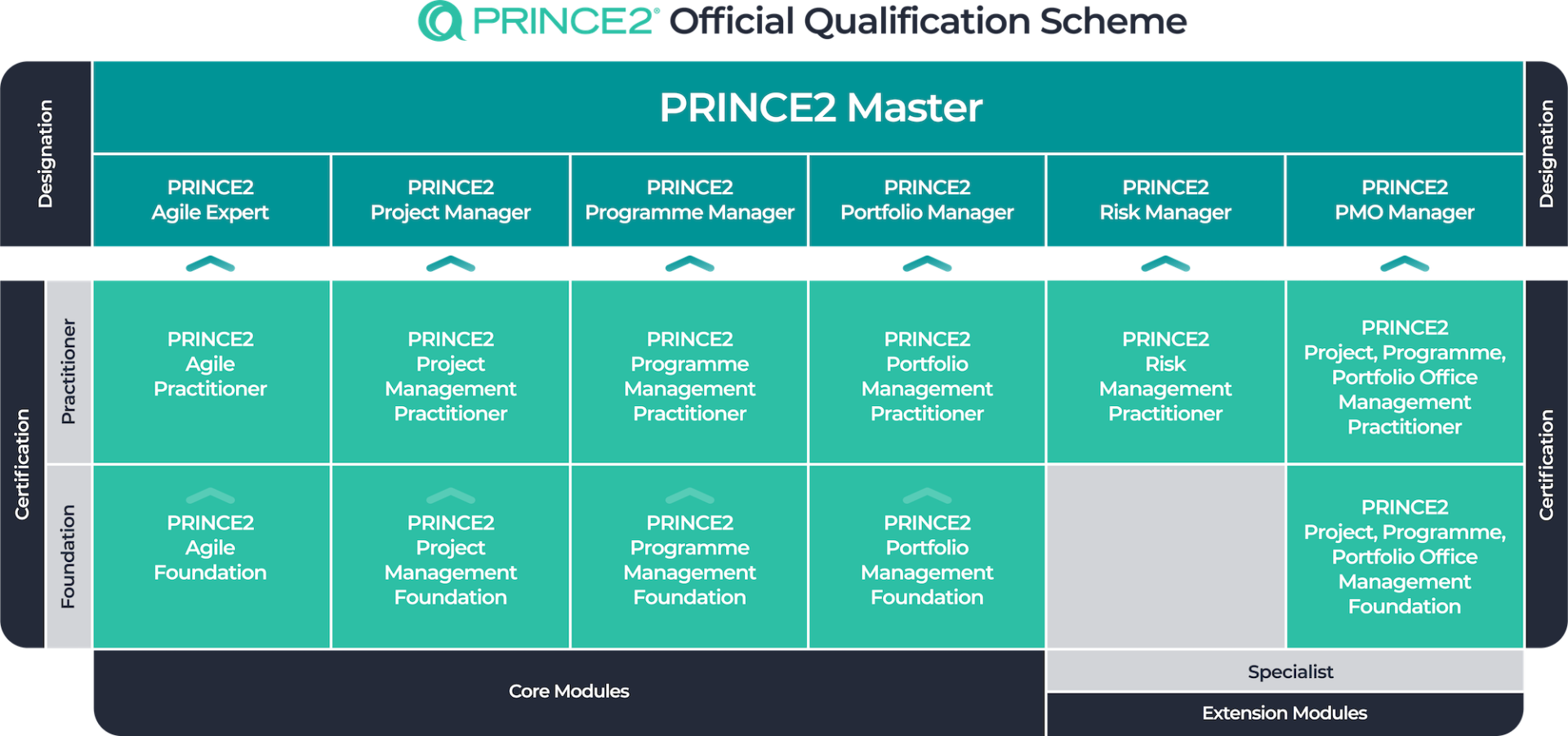
Six designations. Most are a Foundation plus a Practitioner. One is a single module.
Start here: PRINCE2 Project Management Foundation
For most people, PRINCE2 Project Management Foundation (Version 7) is the entry point. It has no prerequisites, so you can start with no prior project management certification at all.
Foundation covers the method as a whole: the seven principles, seven practices and seven processes, the key project roles, and the areas Version 7 brought forward, namely people management, sustainability, and digital and data management.
Exam: 60 multiple-choice questions, 60 minutes, closed book, 60% to pass.
Foundation on its own is a legitimate destination. If you work on projects rather than running them, meaning a team member, a subject expert, or someone who needs to speak the language in a PRINCE2 organisation, Foundation is often all you need.
What actually changed in Version 7
Version 7 is an evolution, not a rebuild. If you know PRINCE2 6th edition, you will recognise most of it.
The six designations
PRINCE2 Project Manager
The core route, and the one most employers mean when a job advert says "PRINCE2 required".
Always check prerequisites before you book. PeopleCert updates the accepted prerequisite list as new versions are released, and older versions drop off it over time. The list above was correct in September 2026. Confirm the current requirements on the official PeopleCert page for your module before you buy an exam voucher.
That list matters. If you already hold PMP or an IPMA level, you can go straight to PRINCE2 Practitioner without sitting Foundation first.
PRINCE2 Project Management Foundation (Version 7) first, as above, then PRINCE2 Project Management Practitioner (Version 7), which is about applying and tailoring the method to a real project rather than reciting it.
Practitioner exam: 56 questions and sub-questions worth 70 marks, 150 minutes, open book, 60% to pass.
Practitioner prerequisites. You need any one of:
- PRINCE2 Project Management Foundation (Version 7)
- PRINCE2 6th or 5th Edition, Foundation or Practitioner
- PMP or CAPM
- PPQ or PMQ
- IPMA Level A, B, C or D
Always check prerequisites before you book. PeopleCert updates the accepted prerequisite list as new versions are released, and older versions drop off it over time. The list above was correct in September 2026. Confirm the current requirements on the official PeopleCert page for your module before you buy an exam voucher.
That list matters. If you already hold PMP or an IPMA level, you can go straight to PRINCE2 Practitioner without sitting Foundation first.
PRINCE2 Agile Expert
PRINCE2 Programme Manager
PRINCE2 Portfolio Manager
PRINCE2 PMO Manager
PRINCE2 Risk Manager
PRINCE2 Master
PRINCE2 or PRINCE2 Agile: which one?
The most common question, and the answer is usually simpler than people expect.
Exam formats at a glance
Choosing in one line
- Never certified, traditional projects: Project Management Foundation
- Never certified, agile teams: PRINCE2 Agile Foundation
- Certified, want to go deeper: the matching Practitioner
- Hold PMP or IPMA: straight to Project Management Practitioner
- Moved from managing projects to managing programmes: Programme Management Foundation
- Decide what gets funded: Portfolio Management Foundation
- Run or build a PMO: P3O Foundation
- Risk specialist: Risk Management Practitioner
Getting certified with AGILEPM HUB
AGILEPM HUB is a PeopleCert Accredited Training Organisation. Every accredited eLearning course includes the full course, the learner resources and the PeopleCert exam voucher, so there is nothing further to buy to sit the exam.
Foundation courses also include the official eBook. Foundation and Practitioner share the same official manual, so the eBook arrives with your Foundation course and you keep using it when you move up to Practitioner. PRINCE2 Risk Management Practitioner is the exception: it is a standalone module with no Foundation level, so no eBook is included.
Learners in eligible countries can claim a regional discount. Check whether your country qualifies →
Project management 👉 PRINCE2 Project Management Foundation (Version 7) 👉 PRINCE2 Project Management Practitioner (Version 7)
Programme management 👉 PRINCE2 Programme Management Foundation 👉 PRINCE2 Programme Management Practitioner
Portfolio management 👉 PRINCE2 Portfolio Management Foundation 👉 PRINCE2 Portfolio Management Practitioner
Advance your career with flexible, practice-driven training in Product Management, Product Ownership, Service Management, and Project Leadership
Copyright © 2026 AGILEPM HUB
ITIL® and the Swirl logo are registered trademarks of the PeopleCert group. Used under licence from PeopleCert. All rights reserved.
PRINCE2® and PRINCE2 Agile® are registered trademarks of the PeopleCert group. Used under licence from PeopleCert. All rights reserved.
AGILEPM HUB is a PeopleCert Accredited Training Organization (ATO) for ITIL® and PRINCE2® in Hong Kong.
You can check our profile page: https://www.peoplecert.org/ways-to-get-certified/ato/agilepm-hub-2762171
Created with